
Heavy snowpack builds moisture reserves, farmers watching Spring melt
FORT ST. JOHN – As winter wraps up, and the snow begins to melt, both the provincial and federal governments report that the Peace was the only region of the province where the snowpack was well above normal on March 1.
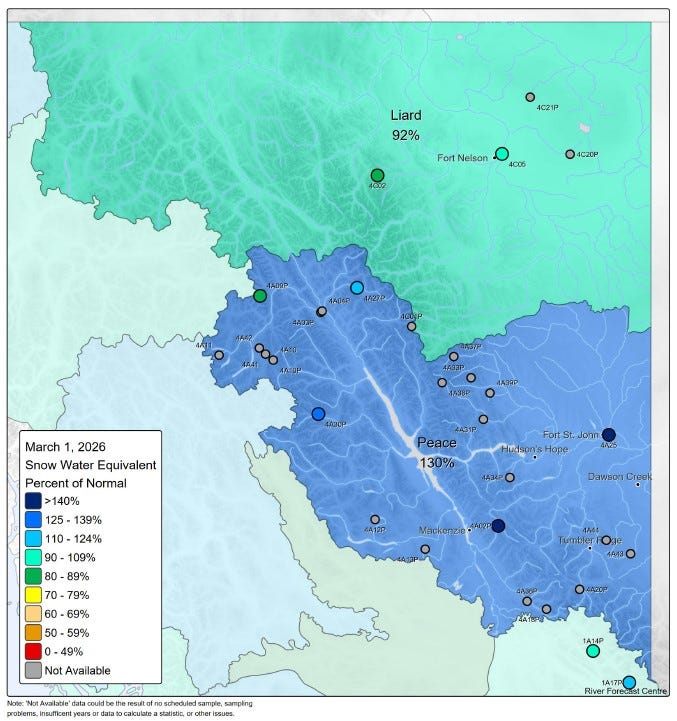
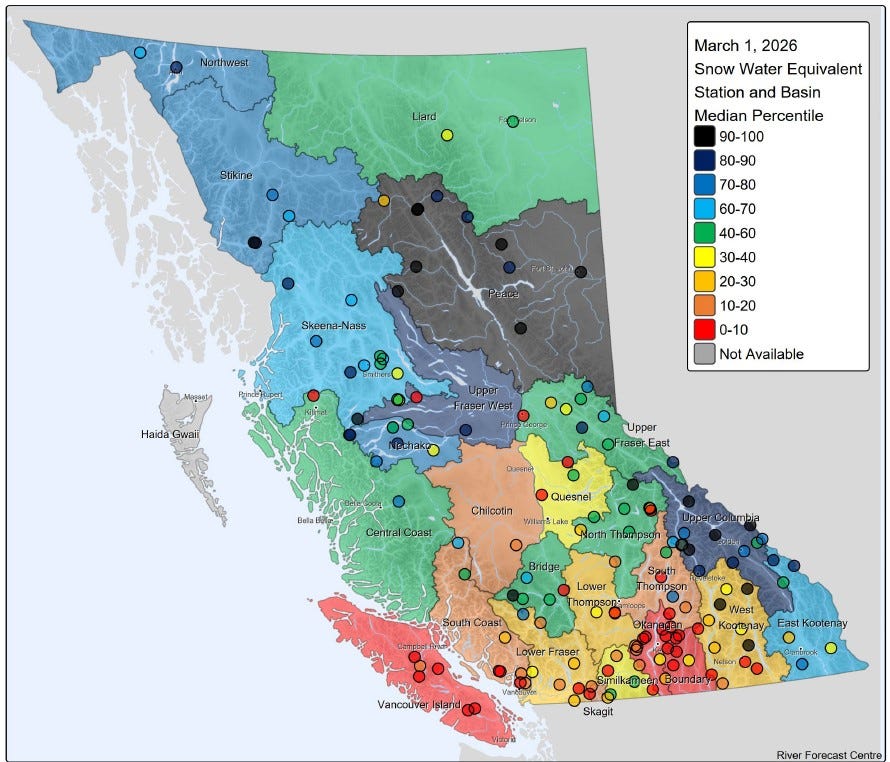
British Columbia’s Ministry of Land, Water and Resource Stewardship’s Snow Survey and Water Supply Bulletin shows that the overall provincial snowpack is slightly below normal to March 1, with the average snow measurement at 91 percent of normal. Meanwhile, in the Peace Region, the Snow Basin Indices (SBI) is at 130 percent of normal, and the average Snow Water Equivalent (SWE) – in the 85th percentile – is the highest in the province.
The higher-than-normal snowpack led to Agriculture and AgriFood Canada’s Canadian Drought Monitor reporting an overall improvement in drought conditions. In Northern BC where “significant improvements were observed” the Moderate (D1) conditions in the northeast corner of the Peace, and near Dawson Creek the Moderate (D1) and Severe Drought (D2) conditions were reduced.
For growers and producers in the Peace Region, a snow basin index of 130 percent of normal is generally a good sign. Coming on the heels of several years of severe drought, it offers a better starting point for the growing season.
But it doesn’t offer a guaranteed outcome, says Peace River Forage Association coordinator, Nadia Mori.
A higher-than-normal snowpack can improve spring runoff, help recharge dugouts, streams, soil moisture reserves, and reduce some concerns going into spring.
“What matters next is how the snow comes off, how much of that moisture actually infiltrates, what subsoil moisture looks like going into seeding, and what kind of rainfall and temperatures we get through May, June and July,” Mori told the broken typewriter.
The 2025 drought summary showed that conditions had improved substantially over 2022-2024, but that recovery was uneven, and areas like the South and East Peace could still be vulnerable, depending on both this year’s snowpack, as well as spring and summer weather.
Near normal temperatures are expected for the northern Peace region this growing season, and according to the Bulletin, there is likely to be “above normal precipitation for March through May 2026” for several regions, including the Peace.
Mori is encouraged by the current snowpack. “[It] should be viewed as a meaningful improvement from recent drought years, but it is still too early to declare the drought fully behind us. The next phase of spring weather will tell us a great deal.”
The way the snow melts in the coming weeks will determine how seeding goes. The BC Water Supply Bulletin warns that because of the current snow conditions, there is an increased risk of spring snowmelt flood, including in the Peace region. If the snow melts gradually and the ground can take in the moisture, it would be beneficial. But if it melts too quickly while the ground is still frozen that water could become run-off instead of useful stored moisture.
North Peace Cattlemen’s Association president, Braden Sutherland, is hopeful that that the snowpack will end the drought conditions the region’s producers have been suffering through in the last few years.
“The ground is so dry and water tables are so low that it will take at least all this snow and more to replenish, but I am certain this will make a significant difference in replenishing dry dugouts, and improving the grassland and forest conditions,” he said. “Pastures and hay fields should do well if summer ever comes.”
Mori says the issue heading into planting for local farmers isn’t just having snow on the land in March, but whether fields dry out and thaw in time for normal field access.
“Producers generally want a gradual melt followed by conditions that allow soils to warm and equipment to get on the land without causing compaction or rutting,” she said. “If snow persists too long into spring, or if fields stay wet and cold, seeding can be delayed.”
In light of this week’s additional snow, Sutherland said, “I am concerned now that its going to be difficult to get any crops in the ground in time.”
Most producers would rather start with good moisture and a slightly later field entry, than go into spring with bare, dry fields and continued moisture deficits.
“What will matter most over the next several weeks is the timing of thaw, drainage, field trafficability and whether weather in late April and May supports a reasonably timely start,” Mori said.