
FSJ relying on IPD model, grants and regional support for new aquatic centre
As the City of Fort St. John takes its proposed $185-million aquatic facility on a regional roadshow – pitching to the Peace River Regional District board in late July, and to the Districts of Taylor and Hudson’s Hope this week – a central question for taxpayers remains. How does the city plan to keep a project of this scale within budgetary and borrowing ceilings?
A big part of the answer rests on a non-traditional construction framework called Integrated Project Delivery (IPD).
When it comes to large-scale projects like municipal facilities, design changes during construction can lead to delays and cost over-runs. By using the Integrated Project Delivery model for the design and construction of its new aquatic facility, the City of Fort St. John hopes to avoid increasing costs through delays and change orders.
During a recent Committee of the Whole presentation, Jen Hancock, VP of collaborative construction at Chandos Construction, outlined how the IPD model works and where its use has saved time and money for other Canadian municipalities.
Unlike traditional construction, where contractors are handed plans and told what to build, IPD brings experienced team members together to collaborate and refine plans before construction begins.
Because any design changes become more costly the closer a project gets to actual construction, bringing trades into the design process early is meant to reduce wasted time and head-off costly mid-construction change orders.
“We’re trying to maximise that value, with minimising wasted time, effort and energy – and we do have that ability to do that in an IPD setting,” Hancock told Council, noting the goal is to deliver a high-quality facility within budget.
According to Hancock, the IPD contract is split into two phases: Validation and Project Execution.
The validation phase serves as a critical checkpoint where the project team determines whether the facility can be built for the city’s target price tag.
“This is basically a go-no-go gate for the city – for us to figure out if we can actually build what you need, for the price you need to do it, with a lot more detail in there,” she said.
The validation process takes time, and Hancock says the team will not be done with the validation in time for the referendum.
“We would not be done validation, likely until December,” she said.
Therefore, voters will be asked to approve borrowing for the facility in the October referendum, yet the formal IPD validation phase – with its firm numbers – won’t wrap up until two months later.
“We have to figure out all the timelines, but just to give you a rough idea, that document will be finished around December, but we’ll have a pretty good sense of the work before the referendum of course.”
The goal of the process isn’t total certainty, rather enough risk-reduction that the project team can lock in a binding target cost.
“How much information do we need to have, so when it comes to this facility, the fieldhouse, the pool, how much information do we need to have that will give us cost, essentially, that it’s going to have all of these components in it and we can build it in this much time for this much money,” she said, adding: “We’re really trying to get confidence with the price. It won’t be perfect, but we are committing to that.”
Another way to reduce costs to taxpayers, is to reduce the amount the city needs to borrow, by seeking federal and provincial grants. A delegation, made up of members of council and city staff have been presenting the latest on the proposed new aquatic facility to regional governments and seeking letters of support for grant funding submissions. Through these grants, the city hopes to reduce the borrowing amount by one-third, to a more palatable $60 million.
“Our goal on the capital side of it is really the province and the feds,” Councillor Trevor Bolin explained in response to questions from the PRRD board on July 23. “There are some great grants that have not only just been released, but there are some further grants that are coming out very shortly.
“So that’s where we’re going to see that up to $90 million come down to $60 million,” he added.
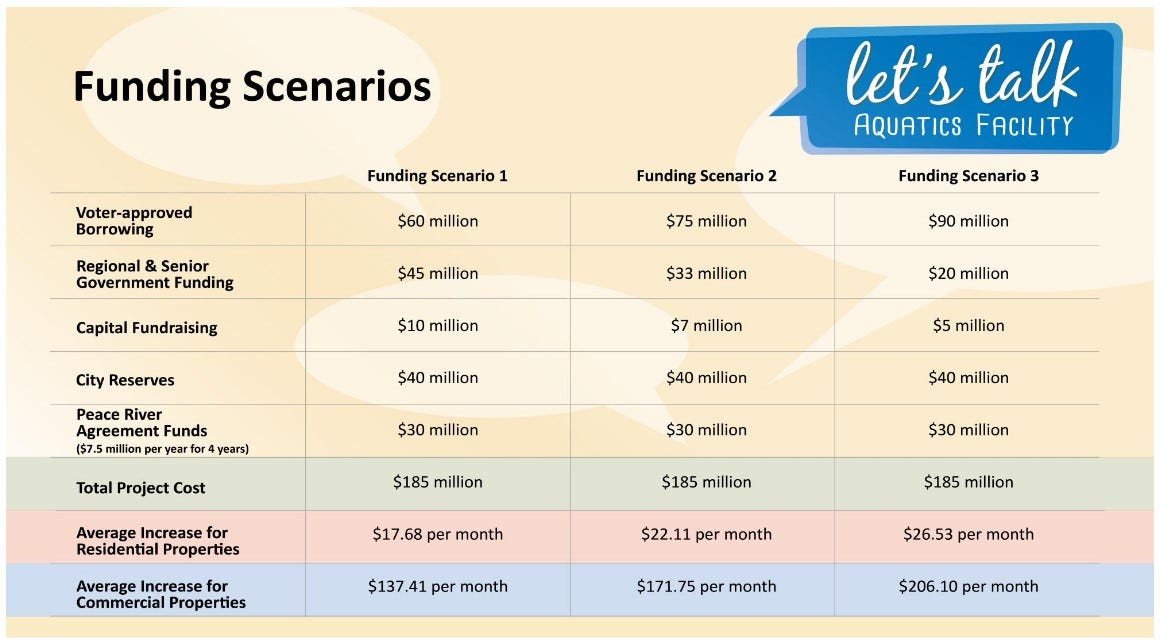
Tumbler Ridge director and mayor Darryl Krakowka, referring to the $30-$40 monthly increase Bolin has cited, noted that this would equal up to approximately $500 per year in additional residential taxes.
“What happens if the referendum is a no? Where do you guys move on from there?”
Bolin replied that that will become a larger discussion “because the North Peace Leisure Pool does not have that many years left.”
In September 2017, at a Special Pool Commission meeting, the North Peace Leisure Pool Commission, which operates the existing pool, was told that the current pool would need to be replaced or repaired in the next ten to twelve years.
“We have spent eight of those ten to twelve years in this process,” said Bolin. “So, if the referendum is a no, Fort St. John could then go back to its residents and say, maybe we get rid of the fieldhouse for now. What does it look like as an aquatic facility?”
“We do have a backup plan, and we know that there’s going to need to be backup plans, I don’t think we’ll need to use it,” he said.
Bolin added that in his 18 years on Fort St. John City Council, he has “never seen this level of engagement and transparency with anything that’s ever been done in any form of local government. So, I would be really surprised if the residents did come back with a no.”
As the roadshow continued, explanations of costs certainty differed across presentations.
In the August 10 presentation to Taylor Council, Councillor Sarah MacDougall stated the city had already advanced to Class C estimates, so voters could be assured of firm figures ahead of the referendum. She described the remaining work as “just kind of getting all our i’s dotted and our t’s crossed, so the general public can understand what they’re voting on.”
The funding scenarios presented to regional governments are the same ones shown on the city’s Let’s Talk Aquatics Facility page. That page states the figures are based on Class D estimates – a conceptual phase which includes a built-in 20 percent construction contingency. Class C estimates are preliminary design calculations, typically based on designs that are 15 to 33 percent complete and carry a standard accuracy range of roughly +/- 15 to 20 percent.
City officials have stated that both the $185-million project cost and the $90-million referendum borrowing amount are firm, non-negotiable ceilings. Project lead Hancock has noted that the $1.2 million IPD validation process intended to establish those firmer numbers isn’t expected to conclude until December – two months after the referendum.
Councillor Desirae Graziano asked the delegation about the future of the existing Kids Arena Fieldhouse and the location of the proposed new facility.
On the fieldhouse, Bolin said there are ongoing discussions with North Peace Gymnastics about taking over the facility once the new facility opens. As for the site of the proposed development, Bolin assured Taylor Council that it was locked down: “The location is secured. We had a developer in Fort St. John who donated just over 10 acres of land – it is located on what was known as the West Bypass, it’s now 116th Street, across from Ma Murray School.”
However, when the donation was announced in October 2025, it was framed as conditional – contingent on the project passing the borrowing referendum on October 17. If the referendum does not pass, the donation expires, leaving the city without a secured site.
Overall, the delegation was well received by the regional governments and received positive feedback. While the Peace River Regional District voted to defer a letter of support until after Area C director Brad Sperling could review the presentation, both Taylor and Hudson’s Hope councils agreed to provide the letters of support.
The Broken Typewriter contacted the City of Fort St. John for an update on the status of a Plan B and the conditions of the land donation. A response was not received in time for publication.