
At last: Innergex responds to PRRD concerns
Board receives long-sought clarity on key issues
Ever since Innergex first answered BC Hydro’s 2024 Call for Power by proposing the Four Winds Energy project (formerly known as Stewart Creek Wind), regional district directors have been looking for answers to key questions on behalf of their constituents.
Now there are two projects proposed for the South Peace – Four Winds Energy and Bessie Wind – by Innergex, in partnership with West Moberly First Nations. Yet many of the same questions remain and were posed again at Innergex’s most recent presentation to the Peace River Regional District’s board of directors meeting on June 25.
The projects were both awarded Energy Purchase Agreements (EPA) by BC Hydro following the 2024 and 2025 Calls for Power, and the company has been proceeding with studies and consultations, along with periodic updates to the PRRD via presentations.
But regional directors and landowners have struggled to get satisfactory answers.
Primary concerns for landowners centred on the direct disruption to agricultural operations, specifically, how much land will be stripped out of production during the construction phase, the permanent physical footprint of the project, and the tax implications for a private landowner hosting a commercial utility.
In December 2024, shortly after Four Winds (then called Stewart Creek) received its EPA, directors discussed the project at an electoral area directors meeting. At the time, Area C director Brad Sperling expressed his concern over the Province’s removal of the requirement for an Environment Assessment to be conducted on wind projects, as well as a lack of feedback on the board’s request for cumulative impact studies.
That concern cropped up again at a May 2025 meeting, where Innergex presented the proposed Four Winds Energy project to the board:
The regional board has asked several times for commitments for the province to provide cumulative impact assessments, reclamation and responsible asset disposal plans, and economic benefits agreements for all these proposed projects, to no avail.
“You look at the responses we get from the Ministry of Energy; they basically brush off our concerns about cumulative effects. We’ve got these wind farms going in next to oil and gas wells, that’s cumulative. It’s not just wind farms,” said Sperling.
At the June 25 meeting, Innergex gave the third presentation on its proposed projects in 14 months, where Sperling again asked Mike Goodman, Innergex’s Senior Development Manager about cumulative effects:
“Let’s start with cumulative effects. It’s up to the proponent to do a cumulative effect study. When you’re doing your [field] study, does that include anything else that’s happening in the area? Like the oil and gas, farming – does it take that into effect? How much has already been disturbed on the land?”
“Yes, it will,” Goodman said, finally giving Sperling the answer the PRRD had been seeking since the first Call for Power went out in early 2024.
Potential loss of agricultural land deeply concerning
Prior to Innergex’s presentation, local landowner Audrey Issac took advantage of the Gallery Comments or Questions section of meeting, to present her concerns to the Board and the Innergex representatives.
Issac said that the lease outlined in the contract isn’t just for the parcel of land that the turbine would be located on but is for the whole quarter section – 160 acres – and that the land would be put in Innergex’s name.
“We were given three different reasons why, and none of them really fly,” she said.
Fort St. John alternate director Trevor Bolin was also curious about “the land being transferred into [Innergex’s] name during the timeframe of the project.”
Goodman replied that it would only be during the development phase to give the company “flexibility in design” when it comes to planning exactly where the wind turbines would be located on a particular property, and to understand the entire layout over neighbouring properties.
“We’re going to work together to kind of figure out where the best placement of that is; so that’s where we need the flexibility within the contracts,” Goodman said.
“We don’t take title. It’s still their land; we’re not looking to purchase any land. We just want to have a lease for our project – for the development and then constructions and through the operation term.”
The potential loss of agricultural land has concerned the regional district’s directors for years and is something they have consistently been vocal about.
“We don’t take title. It’s still their land - we just want to have a lease for our project.”
Mike Goodman, Senior Development Manager, Innergex
“This loss of ag land is very, very difficult,” Pouce Coupe director Danielle Veach told the Innergex team.
Having two calls for power impacting the Peace Region, two years in a row, plus the province’s suggestion that they’re looking at putting a fourth dam on the Peace River, will eventually “make our entire region look like a quilt of just never-ending power projects,” Veach said.
Losing prime agricultural land means reducing our ability to produce food – something that Veach says has already occurred in the Okanagan when land was taken out of the Agricultural Land Reserve for housing.
“It’s extremely frustrating because, sure your car can run, but if you don’t have food to eat, you’re going to be pretty tired while you’re driving it.”
Area directors who are farmers themselves, particularly Area E’s Dan Rose – whose region faces the direct impact of the projects – have consistently echoed the anxieties of their constituents.
Rose voiced his concerns surrounding the lack of precision around exactly how much land Innergex wants for the wind farm.
“I think it’s a little bit disingenuous that you come here and tell us that you’re only going to use an acre per turbine, yet you just told us that, for siting, you need to have the whole quarter, because you haven’t really decided what your footprint is going to be yet,” Rose said.
For example, if the footprint of the turbine is in the middle of the quarter, road access is needed, as are power lines, which BC Hydro doesn’t allow on the rights-of-way, Rose pointed out. All that will be taking up agricultural land.
When oil and gas leases are on agricultural land, those are surveyed out and taxed at a different rate.
“I don’t think you’re paying the industrial rate on the whole quarter of land because if you were, the whole project wouldn’t be feasible,” Rose said.
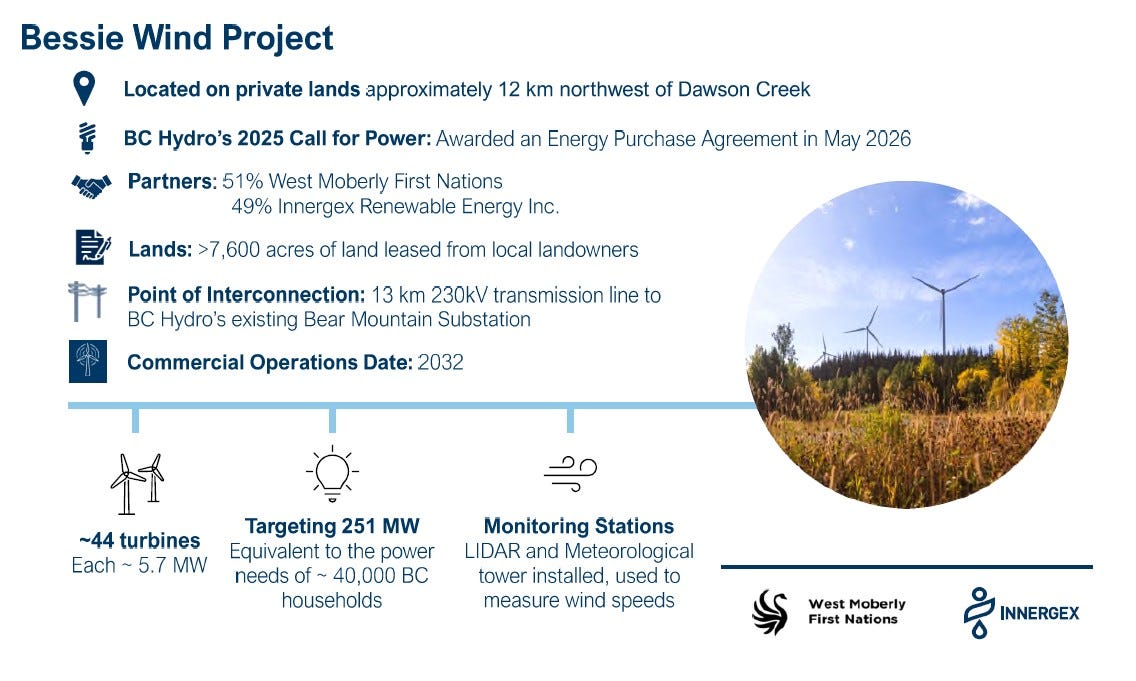
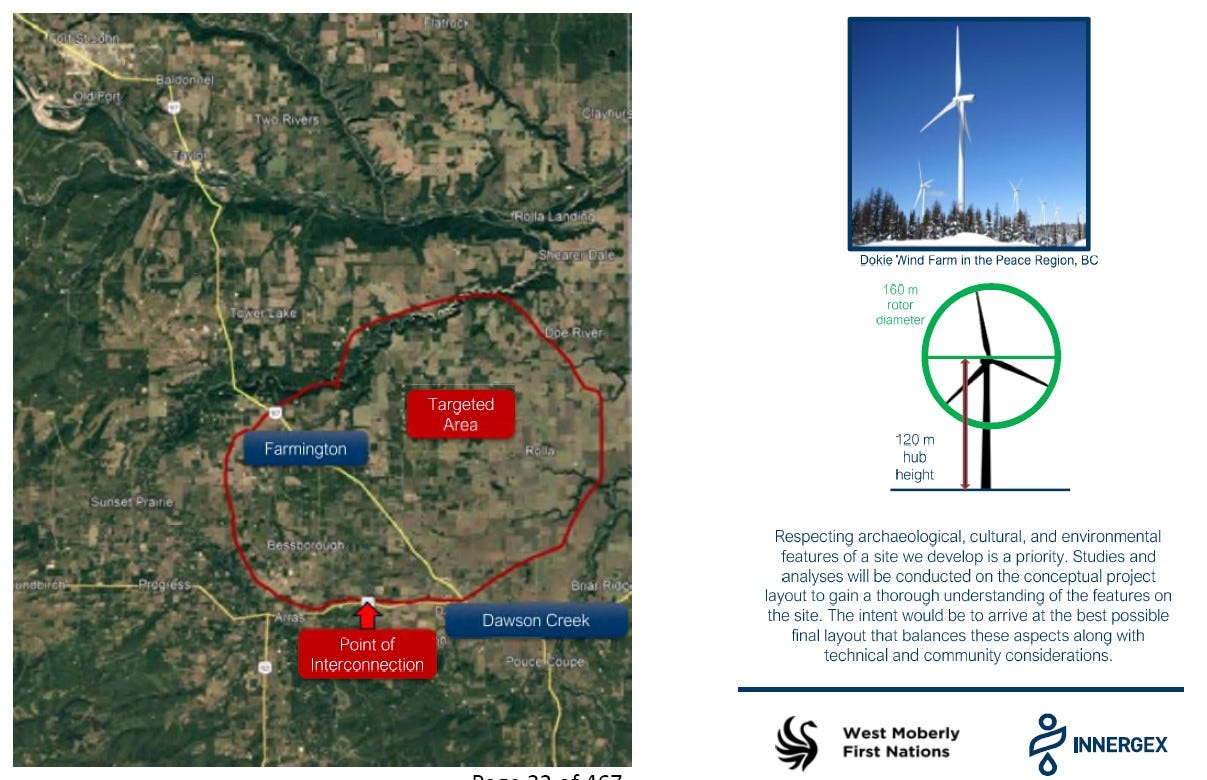
There is a greater footprint than just the 44 turbines, Goodman admitted.
“That’s an endeavour for next time when we come back is to present the full project area, not just turbines, but the feeder lines that may go underground or above ground, the substation, the roads to access the turbines, the transmission line that will go from our project substation down to BMT [Bear Mountain Transmission].”
Taxation – who benefits, who pays
The benefits to the Regional District in the form of taxation, has been a concern for the board since the beginning.
In December 2024, Sperling pointed out there appeared to be no taxation other than on the road in and the road out, of the Stewart Creek (Four Winds) project.
When he brought up the issue again at the most recent meeting, Sperling described the taxation from the existing wind farms in the region as “a pittance compared to any other industry.”
Yet the numbers provided by Innergex on the Bessie Wind project show approximately double the taxation from existing wind farms.
While he wasn’t prepared to answer regarding Four Winds, Goodman explained that for Bessie there’s a mill rate for the turbine structures; the project area has a separate mill rate, which includes the substation, transmission line and feeder lines.
“You combine those two and you get to a number,” Goodman said. “We have a finance team that puts that together and compounds those numbers.”
For landowners, the financial unknowns extend onto their fields.
Issac said that the contract with Innergex doesn’t clearly define the tax impact on landowners. In an effort to get answers, she called various provincial government departments, starting with the Land Commission and ending with BC Assessment.
The person she spoke to at BC Assessment said it would be taxed at a higher rate, as it would be a utility.
“If it’s taxed at the utility rate, nobody’s going to be able to afford it,” Issac said.
Goodman was able to provide answers on the Bessie Wind tax impacts for landowners:
“The project [Bessie Wind] will pay the tax rate for the project area, and the landowner will continue to pay the farm tax and whatever other use they have on-site.
“If it’s taxed at the utility rate, nobody’s going to be able to afford it.”
Landowner Audrey Issac
“So that farm tax will be the landowner’s concern, and the property tax associated with towers, the substation, the wires will be the project’s responsibility.”
Can landowners say no to turbines?
“You said every landowner has the option whether they want this on their property or not,” said Area B director Reid Graham. “What about the person that lives directly across the road from a proposed site?”
Given that the turbines for Bessie Wind are significantly larger – at 200m tall, including the blades – than the existing wind turbines in the region, means that although there will be fewer, they will have a greater visual impact.
To reduce the impacts from both noise and visual clutter, Goodman said that there are setbacks of “820m away from each occupied building, so home or business.”
“We really try to work within that community to get the right placement,” he said. “There’s certainly a good neighbour aspect of that piece, where once we have a layout, we need to work with those neighbours to make sure everybody gets a fair kind of result.”
What if you don’t come to a “good neighbour” agreement, Rose asked.
“You don’t have the right of expropriation as far as I know, right now. However, BC Hydro does when they want to push through power lines.
“So, what are you going to do?”
Goodman maintained that signing on to the project is “all 100 percent voluntary,” for landowners.
“I think it’s going to be on a case-by-case basis when we get to those situations with landowners and there’s a neighbour.
“Our primary intention is to come to a mutual agreement. We’re here in the community, we’re working hard and we’re listening to feedback.”
Innergex wants to have a positive impact, not a negative one, Goodman said.