
Landowners seek answers from Regional District
People want to have their voices heard: Mayor Hansen
Landowners representing over half a million acres in Area B alone, turned out on Thursday morning, to get answers and voice their concerns about a proposed Land Sharing Network at the Peace River Regional District’s Committee of the Whole meeting.
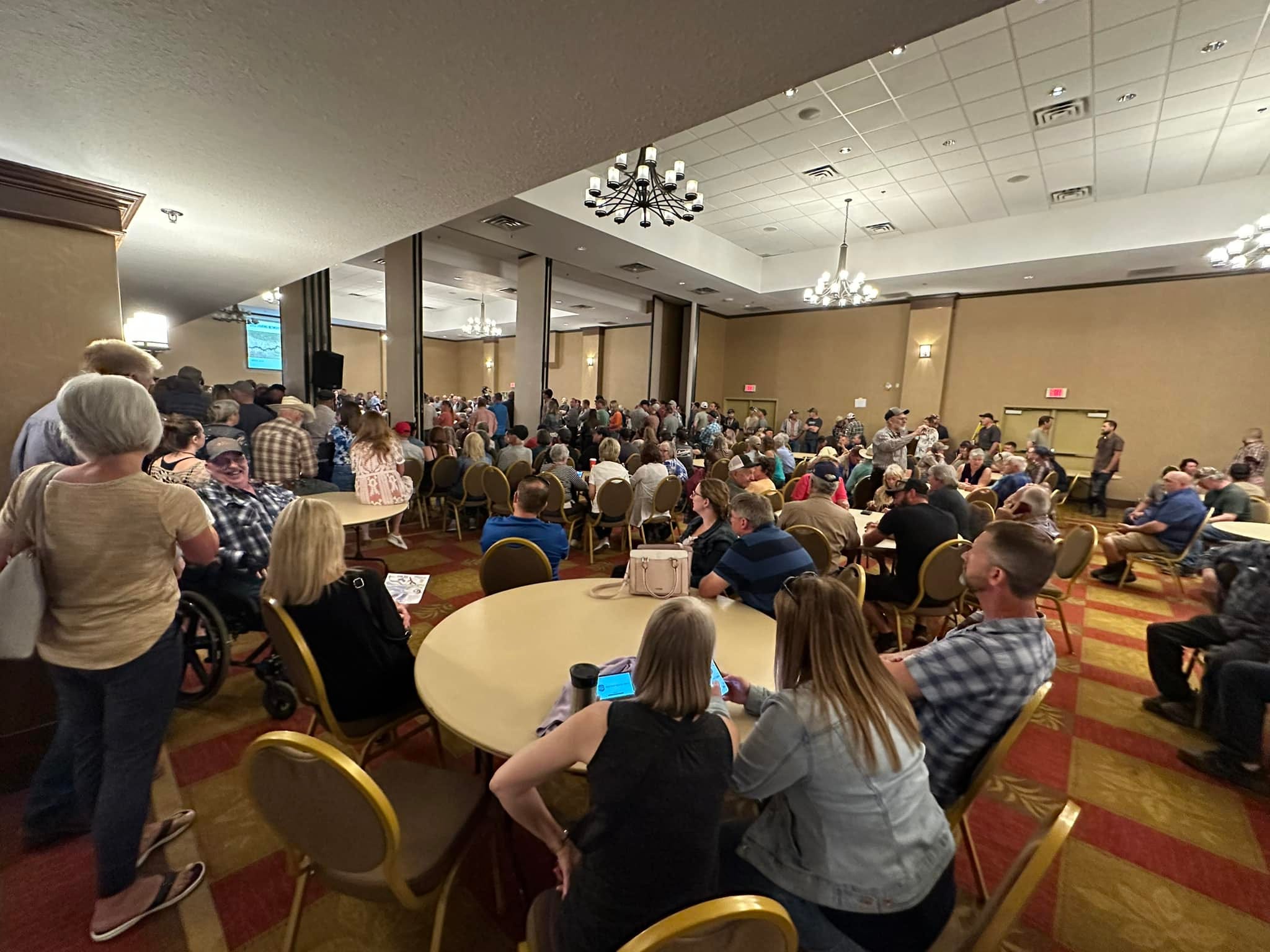
Galvanized by social media posts surrounding the idea for a Land Sharing Network, which was first presented to the Electoral Area Directors Committee in January by Dale Bumstead of SCION Strategies Ltd., and Edward Stanford of Urban Systems, hundreds of landowners from all over the region converged on the meeting. Bumstead and Stanford were invited by the Board to answer questions, and were scheduled to be followed by a delegation expressing their concerns about the concept.
At the January 31 EADC meeting, Bumstead and Stanford presented their idea to the three area directors present. Bumstead said he had been working with four Dane-Zaa First Nations since late 2022, on initiatives that had come as a result of the Blueberry-Treaty 8 court decision. One of these initiatives is Healing the Land – Healing the People, which Bumstead said could be helped by a land sharing network on the model of the Land Sharing Network in Saskatchewan.
“That was really the purpose of the Treaty. To open up the land, for purposes of development for the economic benefits of hunting, forestry, mining and development for agriculture puposes. So now, legitimately so, those lands are developed, and are owned by private land owners. As defined under the Treaty,” Bumstead said.
“What we’re bringing to the board today is this whole aspect of Treaty Land Sharing – I think it’s got the opportunity, in a non-verbal way, a visual way, to demonstrate to the leadership of this region that we’re going to work collaboratively together, with our neighbours in a way that’s going to allow us to move forward in a very positive way.”
Stanford echoed Bumstead’s sentiments, stating that there is an opportunity for a Treaty land sharing network, “on the Saskatchewan model.”
“Ultimately, it’s about that safe and respectful access to land and respecting the traditional ways of life,” Stanford said.
The way the Saskatchewan model works, is that an Indigenous person or family would call the landowner and ask if it’s okay if they come out on this day at this time, Stanford explained. “It’s very similar to asking permission to hunt on private property.”
Stanford said they were looking for support from the EADC “to better understand where the opportunity is here. We’d like to research this a little further, and that takes funds.”
Funds that would come from the federal government Office of the Treaty Commissioner and the provincial Ministry of Indigenous Relations and Reconciliation, with the Regional District potentially being a partner, he said.
“Before we put in the additional work of how to build the model and how we’re going to build policy around that, I wanted to make sure we brought it to the Regional District, and get your input,” said Bumstead. "Then we’ll move forward with the Province and seek their involvement to support us.”
Area B Director Jordan Keely had concerns around the issue of participation being “all in” in the Saskatchewan model – if a landowner agrees to participate, they must allow all aspects of traditional life, including hunting. Keely said that a lot of farmers, himself included, don’t want hunting on their property for a variety of reasons.
The end result, was the letter of support which was drafted following the April 20 board meeting, where Bumstead and Stanford again presented their case to the Regional District.
Fast forward to this week, when the PRRD held it’s regular Committee of the Whole meeting in Fort St. John. Hundreds of farmers, ranchers and other landowners showed up to the public meeting to hear the delegations and get more information about the proposed Treaty Land Sharing Network.
Neither of which events occurred. The meeting was stopped and deferred until the PRRD could find an alternate, higher capacity venue as the amount of people attending exceeded the fire code capacity.
Before the meeting was stopped, the Board were able to ask some questions. Bumstead and Stanford attempted to explain their vision, repeating over and over that it was simply an idea, a concept that Bumstead had brought forward and begun to “do a little bit of work on.”
He said he’d been contacted by both individuals and organisations who wanted him to help facilitate the process, to establish a relationship with their Treaty 8 neighbours.
“We brought it to the directors as the first step in gathering letters of support from organisations, and then we’d start to do some work on it,” Bumstead said. “That’s all we’ve done – there’s no model other than the concept of the idea of building a land sharing network voluntarily with landowners.”
Area C Director Brad Sperling asked Bumstead, “as you move forward, do you plan on having public consultation?”
“Honestly, the first step is to be able to gather that support from entities and organisations,” Bumstead said. “The first step is to be able to engage and build some concepts around this idea and then to start to engage with organisations.”
“It’s the landowners’ decision – how can they make a decisionif they don’t have the information,” Sperling asked. "If and when this moves forward, is there assurance that there’s going to be public consultation, and information that the public can access?”
“Absolutely,” Bumstead said. “We haven’t done any of that yet. This is just the first step of reaching out to you guys who represent the rural folks.”
Fort St. John Mayor Lilia Hansen asked about the liabilities to landowners, if a Land Sharing Network is established, a concern that was also expressed in letters to the Board from the Landry Women’s Institute, and the Nor’ Pioneer Women’s Institute.
“We can’t address the issue of liability because we don’t know what the model looks like,” Bumstead replied. “We don’t know what the model looks like to be able to address liability, to addres structure, to address how people participate or how they don’t participate.”
At this point, the Committee of the Whole meeting was stopped. When the Board reconvened, it was to conduct its regular board meeting. However, the Board was not done with the morning’s events. The issue of the Land Sharing Agreement and the deferrment of the COW came up during New Business.
There was much discussion around the need for more information, and how the Board’s decision to issue the letter of support was perceived by the residents of the Regional District.
Alternate Director Danielle Veach from Pouce Coupe noted that the Board had seen an outcry from the public, and that they need to take steps to regain the public’s faith.
“A lot of people were feeling that that letter is basically giving him (Bumstead) the thumbs up to push this through without listening to the public first,” Veach said. “As a Board, we have a responsibility to hear the outcry and go to the public and find out from them what they’re specifically wanting.”
Director Kealy agreed. “It was pretty clear that the way it was presented, there are a lot of people who are not in favour. If we had a thousand people here today, guaranteed there’s 1,500 to 2,000 people coming next time, because we pushed them away and didn’t give them answers.”
“The whole reason people were here were to get answers and know what’s going on,” he said.
That the Regional Board advise that the Peace River Regional District withdraws support for the Land Sharing Network until SCION Strategies Ltd is able to describe the concept in detail, has provided answers to the landowners about the concept, and had held meetings with the landowners regarding the idea, and demonstrates support from landowners and interested parties.
“I have an area that’s 2/3 of the Peace Region and just looking around the room at the people I know, there was over half a million acres represented in this room, and two associations that represent most of the Peace when it comes to farming. They weren’t in favour of this, and the way it was presented,” Kealy said. “There were other First Nations that are impacted by this as well. They didn’t like this either or the attention it brought to them.”
In the end, the Board voted to withdraw the PRRD’s support for the Land Sharing Network, pending consultation with landowners and demonstrable support from the landowners of the region. They also affirmed their intention to hold the COW at a larger venue and give the delegation a chance to be heard.
“We owe it to those who were here to have some kind of meeting,” said Area E Director Dan Rose.
“People want to have their voices heard,” added Mayor Lilia Hansen.