Land sharing: Work together as neighbours
Lack of transparency causing concern
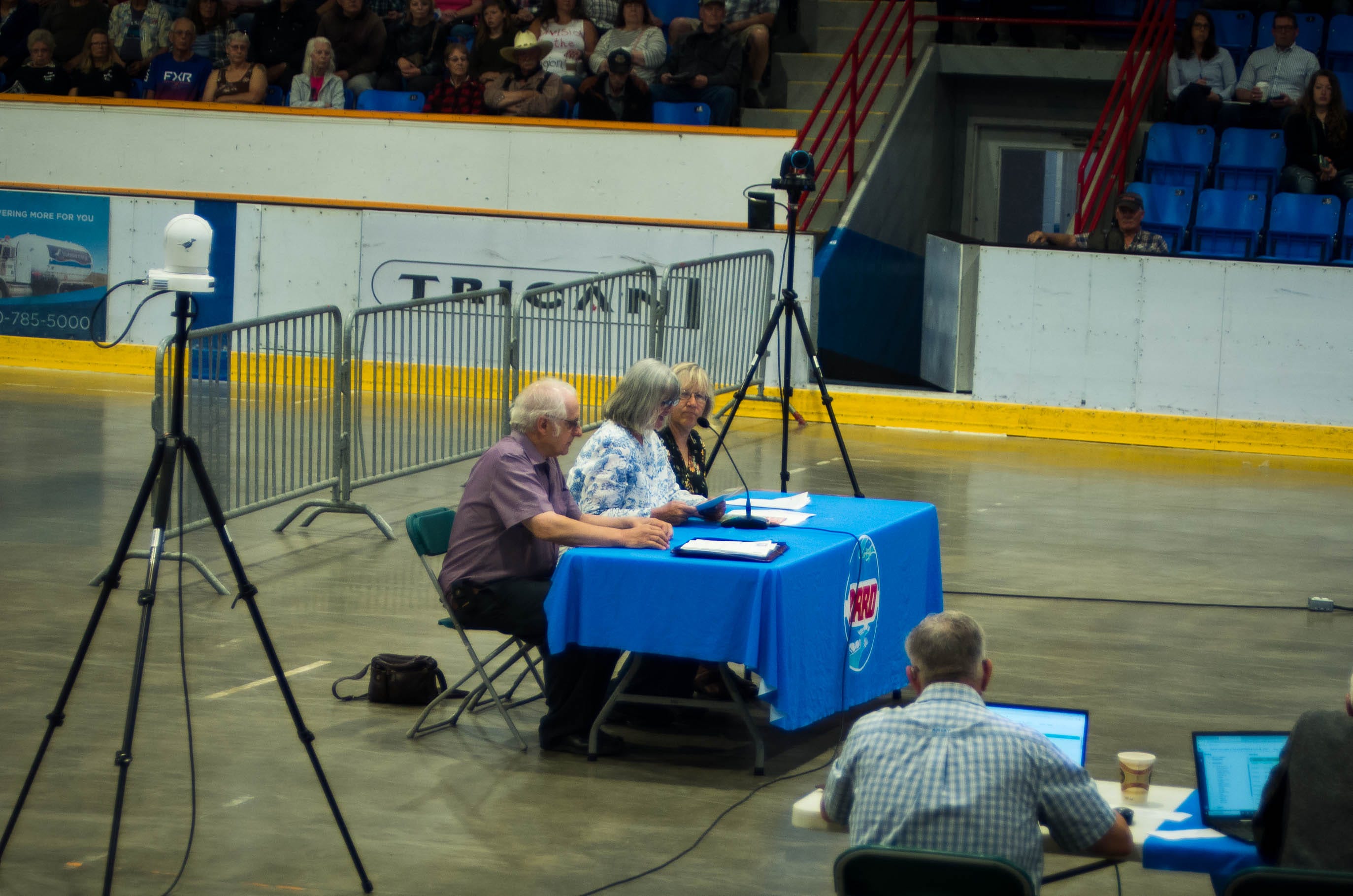
Farmers, ranchers and landowners in the Peace River Regional District finally had an opportunity to give their input to the PRRD’s Board of Directors on Wednesday, after the original meeting was adjourned due to over capacity. Approximately 1,600 people turned out to that meeting, so yesterday’s rescheduled meeting was held at the North Peace Arena, which was able to accommodate all those who were able to attend.
The top concerns of the rural residents were whether a land sharing network is even necessary, given the amount of Crown land available in BC; a lack of transparency on the part of the Board; and a need for everyone to work together as a community, rather than driving a wedge between people.
Sigrid Tobler, VP of the Nor’ Pioneer Women’s Institute, who spoke on behalf of all the Women’s Institutes in the region, pointed out that Treaty Land Sharing in Saskatchewan is still in its infancy, and that “it arose out of a deadly incident involving trespassing. It would be advisable to to wait and see if the Saskatchewan land sharing model is successful, before attempting to replicate it here.”
“We question the need for Treaty Land Sharing, when the land used for agriculture in our area is a very small percentage of the land base in the Treaty 8 territory,” Tobler said. “The majority is Crown land that can be accessed by the public, including for the purpose of traditional Indigenous activities.”
Landowners, Tobler said, want not only to be informed, but consulted when issues arise that affect their livelihood. She suggested that re-establishing the Agricultural Advisory Committee would go a long way to reassure rural residents that their concerns regarding land use and their way of life are taken into account.
“We must build relationships based on trust, respect, understanding and transparency among all those involved in the process in order for us to work successfully on our common goals: To live in harmony with the land and its people.”
Most of the land being discussed in the land sharing proposal is in the Agricultural Land Reserve, explained Helen Harris, who spoke on behalf of the Peace River Regional Cattlemen’s Association. The ALR was established in the 1970s to protect BC’s valueable agricultural land. In the ALR, agriculture is recognised as a priority use, and all non-agricultural uses are restricted.
“[This] means that we cannot just do what we like with our land,” said Harris. We have many government regulations and oversight regarding our crops, our livestock, animal health and welfare, including biosecurity, safety, liability, and rules about invasive weeds coming in on other people’s motor vehicles. We take the stewardship of the land very seriously.”
Farmers and ranchers care about the future of First Nations, and are not opposed to their agreements with the BC government. But agriculture doesn’t seem to be part of recent agreements. People in agriculture are concerned for the future of their children and grandchildren, should they follow in their parents footsteps, Harris said.
“People in agricuture make up less than two per cent of Canadians, and our farmers are quitting,” she said. “Mutual respect and support from First Nations and also from our urban neighbours for agriculture, would go a long way to heal rifts and allay concerns regarding our future and providing food security.”
Harris said that she had asked the Cattlemen if they know of anyone the proponents of the land sharing initiative had spoken to, and they couldn’t find anyone. If the proponents contact the local and regional cattlemen’s asssociations, to speak to them directly, Harris is certain they will be happy to sit down and talk about intiatives involving agriculture landowners.
The Cattlemen are also uncomfortable with the proposal because the proponents stated it is the first of several initiatives that they cannot disclose because it is secret.
“If the proponents would be open and honest with the landowners, taxpayers, and people in the Treaty 8 region, we can move forward collaboratively on these initiatives.”
Harris said that now that the proponents have heard the Cattlemen’s concerns, she hopes they take them into consideration, and trust that the proponents will consult landowners’ representatives in the future.
“Truthful dialogue and civilised debates are the bones of democracy, and we must be consulted to have true collaboration on these initiatives,” said Harris. “There is no agreement if one party is not invited to the table. It is an honourable move to support First Nations culture in our area. We suppport the move to build relationships and initiatives with our First Nations brothers and sisters in the Peace River Region. We respectfully ask that any decisions made in the future affecting agricultural lands be done with out input from the outset."
Jim Little, retired professional agrologist and landowner, echoed Tobler’s and Harris’ concerns. “The landowners who have contacted me, are not interested in this proposal, and are concerned it could be made compulsory over time.”
He pointed out several incidents where a lack of transparency on the part of both the proponents and the Board, added to the concerns of landowners.
“It was thought, by the public, to be only an information package for the Board to review,” Little said. “The proponents did not provide the public with background information until after the proposal started the controversy.”
Little added that there were several points in the proponent’s presentation that need correcting.
“The land sharing agreement in Saskatchewan covers only a small portion of land,” he said. Thirty-six land contracts ranging in size from 12 to 3,000 acres. Little noted that the agreements vary as to what activities are allowed on the properties. “In other words, these agreements are not all-in, as proposed by the proponents.”
There are also major concerns with having an exit strategy for landowners, should they find it’s not working for them. For the landowners who signed the agreement in Saskatchewan, there is no process to exit the agreement, Little said.
BC, he said, has at least 90 per cent Crown land remaining, which is available to the public, including First Nations. There has not been any significant transfers of Crown land to the public since Little left government in 2002.
“There is a significant amount of land that has been agreed to for transfer for Treaty Land Entitlement and Site C accommodation, land which is estimated to be 160,000 acres. It will include a financial settlement from the Federal government. That deal has been agreed to and is going forward,” Little said.
Transparency on the part of the Board is a concern for Little, and the majority of the members of the public who came forward to give their input following the delegation’s presentation.
“Does the PRRD board represent the people or the proponents on this type of issue,” asked Little. “Attendance at the June 8 meeting indicated a lack of support from the public for this concept.”
“Will the proponents or the Regional District pick up the required liability insurance to participate in this proposal? We have had the experience of having our liability insurance cancelled because of snowmobilers trespassing on our land,” he said.
Little also pointed out that a recent request for land use change to support a daycare, was not only well-advertised, but explained by the planner to the Board. “Future land use proposals for private land should be advertised and involve public meetings.”
Joyce Smith asked why the meeting wasn’t held in the evening as many had requested.
“This place would be over-run. Most people are working right now, so I think it’s grossly unfair that you hold it [during the day] on a Wednesday – which is a great day to have it, but it should be at seven o’clock at night,” Smith said. “I’m getting tired of every government level’s non-transparency. You knew this was happening in January. One director voted it down, everybody else voted in favour. Three times. Why was it not brought to the public’s awareness that there was something going on?”
Sharon Jackson, a rancher and outfitter from Farrell Creek said that they’ve always had a very good relationship with First Nations.
“A lot of the decisions we’ve made over the years have come from consulting with First Nations and it was always a positive experience,” Jackson said. “People are right, what you’re doing is wrong, just wrong.”
“We need to work together to share the land that we so believe in, because the land is who we are, as a people,” said Horse Lake First Nations member, and Area B & C landowner, Pat Jansen.
Renee Ardilll, President of the North Peace Cattlemen’s Association said that talking about it like neighbours, is the way to share the land.
“We don’t need a government program,” Ardill said. “All this is doing is driving a wedge between us and the Indigenous people, which the government is really good at. We all need to be at the table – and leave the government the hell out of it.”
“If we look around the room, we’ll realise that we’re all brothers and sisters,” said Wayne Bell. “It doesn’t matter what race, nationality or anything – we’re all in this together.”
