
It’s a system failure, not a service interruption: PRRD
People are going to die.
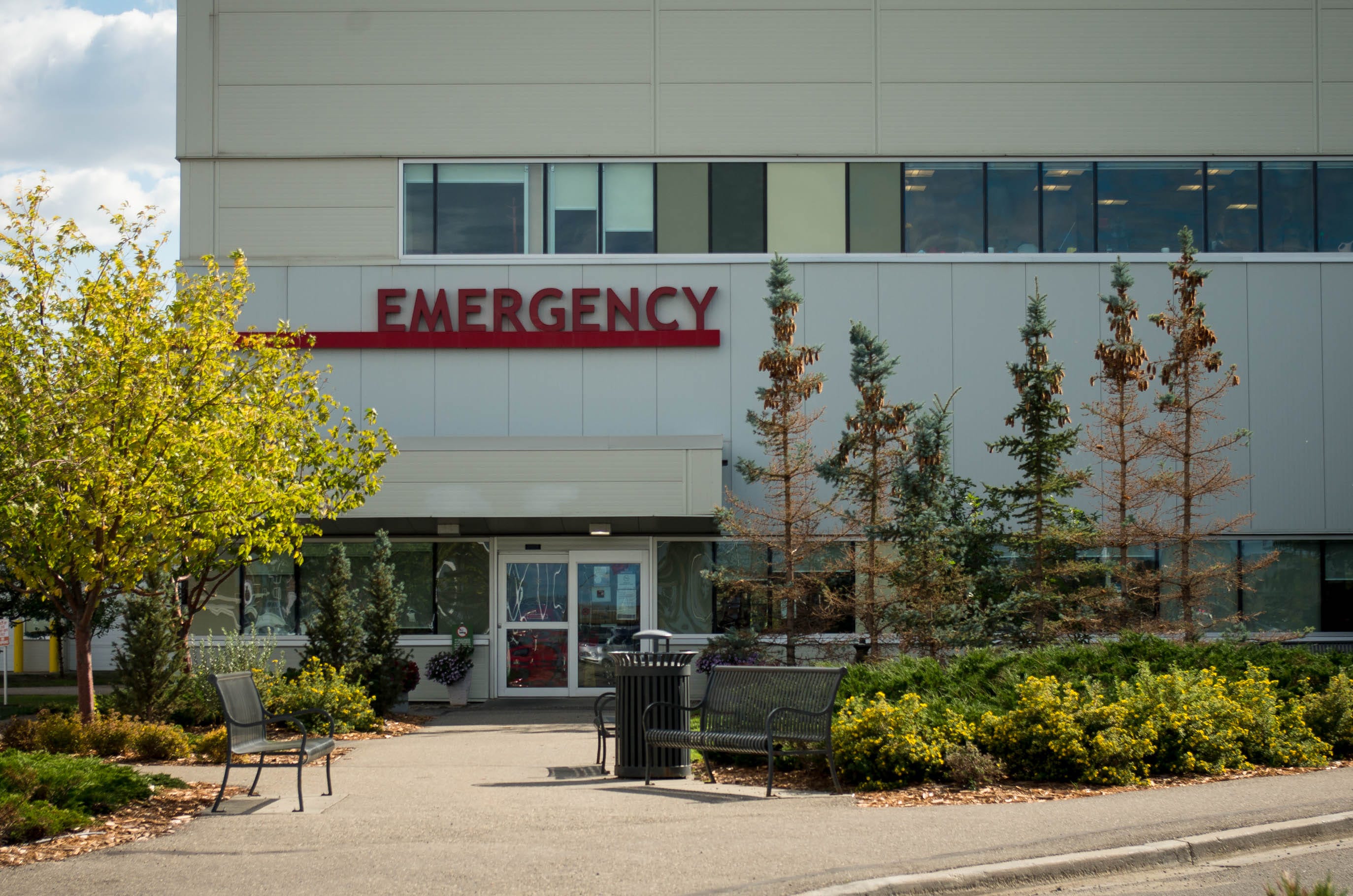
That’s the fear of residents and local politicians in northeastern British Columbia this week, as the region’s largest hospital, located in Fort St. John, experiences one overnight Emergency Room closure after another, and this weekend, the Birthing Centre at Fort St. John Hospital will also be closed, adding yet more anxiety to the 70,000 people in the region.
“One diversion is too many,” Peace River Regional District Board Chair Brad Sperling said at Thursday’s Regional District board meeting. “But now it’s just day after day.”
Despite assurances from Northern Health that the health authority has been working hard to fill shift vacancies and avoid “service interruptions”, for the past week, the ER has been closed every night. That’s on top of simultaneous and repeated ER closures in Fort Nelson and Chetwynd, whose residents would need to seek emergency care in Fort St. John when their ERs are closed.
“It’s not just this region, it’s all across the province. It has to change. When it comes to an essential service, we deserve better.”
Area B Director, Jordan Kealy
If there’s no emergency services available in Fort St. John, patients are forced to travel another 75km to Dawson Creek, compounding an already arduous four-hour journey for anyone from the Northern Rockies Regional Municipality needing emergency treatment.
Pouce Coupe Mayor Danielle Veach says the waiting time at the Dawson Creek Hospital ER, which her residents rely on is nine hours, when the ER in Fort St. John is closed.
“It’s systemic,” said Area B Director Jordan Kealy. “It’s not just this region, it’s all across the province. It has to change. When it comes to an essential service, we deserve better.”
To that end, the PRRD board passed a resolution calling for “an audit of Northern Health, financially, operationally and without prejudice, the workplace.”

The letter calling for the audit will go out to Premier Eby, Minister Dix, North and South Peace MLAs, as well as Northern Rockies Mayor Rob Fraser and all First Nations in the Regional District. It will go out weekly until the PRRD board gets a response, Sperling said.
This is not a new problem, Leonard Hiebert, Area D Director pointed out. “We were in the same situation in 2015. It wasn’t as bad back then, but we were running into the same thing. That’s where the audit comes in. What has changed from back then to now? Nine years later, and we’re actually worse off now than we were back then.”
“There should’ve been a plan at some point to figure this out. I think that’s the target we’re trying to get at with this audit,” Hiebert said.
Directors all agreed that the problem is not with the medical staff at Northern Health. They don’t blame the doctors, the nurses, the medical imaging staff or anyone who is doing their best to keep the residents of northeastern BC in good health.
“This isn’t about any individuals at Northern Health. This is about a system that’s broken, and people are scared. And they have every right to be,” said Sperling.
“That needs to be addressed. If it’s not addressed it’ll be the same situation ten years from now, if not worse.”
Tumbler Ridge Mayor Darryl Krakowka noted that since it’s summer now, the highways in the region are busier, and there’s been a “huge amount of vehicle collisions.”
Kealy agreed. We live in a dangerous region in northeastern BC, he said, and the people here do dangerous jobs. “When there’s 70,000 people in a region, what are the odds that people are going to need to use the emergency room in the night?”
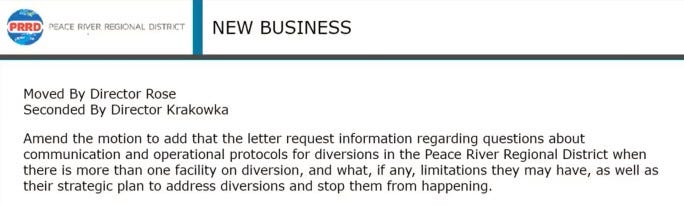
The lack of communication from Northern Health about upcoming closures, which the health authority admits it knows about weeks in advance, frustrates many people. The Regional District directors said that they almost always find out about the coming ER closures an hour prior, on social media.
“Imagine coming from Fort Nelson, and finding out that way,” said Kealy. “Something’s gotta change. That’s why people are frustrated, they have no clue what’s happening, and they just want to know.”
“We’re the front-line guys that are getting the phone calls, hearing the frustrations. The worst part is when they arrive at the hospital, and they find out it’s shut down. And there’s nothing I can say other than we weren’t notified that it would be shut down,” Sperling said.
“Where’s the communication?” asked Sperling. “People are scared.”
Krakowka and Fort St. John Mayor Lilia Hansen said that they do get advance notification from Northern Health when an ER closure is coming. Although Tumbler Ridge puts out a notification to residents right away, Hansen says Fort St. John waits until Northern Health’s announcement before sharing that information with the public.
“When people show up at a clinic and it’s not open, show up at a trauma centre or ER and are told to go elsewhere, people die. Plain and simple.”
Hudson’s Hope Mayor, Travous Quibell.
“We make sure we put out a notice, but it’s not our job, it’s Northern Health’s,” Krakowka said.
The reasons for the delay in announcing coming ER closures are two-fold.
One, Hansen believes is that Northern Health tries “not to cause additional fear and angst when they can possibly head it off. That’s why they leave it as long as they can before they call a diversion.”
The other reason, according to Hudson’s Hope Mayor Travous Quibell, is ministerial interference.
“They’re not allowed to tell us about a diversion until they have approval from the Ministry. That’s problematic because we didn’t learn about out diversion until the day it started. We have a serious communication issue,” Quibell said.
Hudson’s Hope has perhaps had the biggest concerns surrounding the closures. Not only is the community affected by the ER closures in Fort St. John and Chetwynd, but its medical clinic was on diversion from June 6 to 28.
“It was a very long, continuous diversion. It wasn’t a complete shutdown of our medical centre, but both doctors were gone, so services were limited. We had to divert everybody. To underline that, we also lost our ambulance numerous times during that period of time,” he said.
“We are the only BC Ambulance Station that is not full-time in the region. When an ambulance gets lost from another community, ours gets stolen. So, when you have your trauma centre shutdown, no doctors available, limited staff, limited support, and then you also lose your ambulance, it’s a huge issue.”
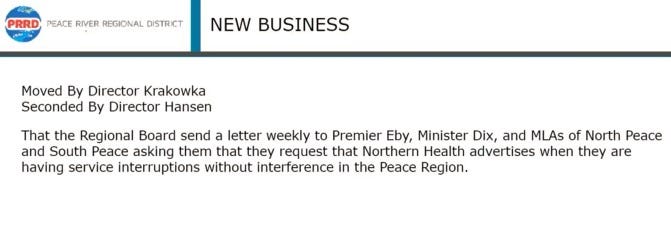
Krakowka moved that the board write another letter to the Premier, Minister Dix and the local MLAs, asking that Northern Health pre-announce closures, without Ministerial interference.
“It’s frustrating and it’s worrisome. When we have these kinds of diversions, and compound them with other issues, when people show up at a clinic and it’s not open, show up at a trauma centre or ER and are told to go elsewhere, people die. Plain and simple,” said Quibell.
In addition to requesting an audit and better communication, Sperling also moved that the board invite Northern Health Chief Executive Officer Ciro Panessa to attend a Committee of the Whole meeting as soon as possible to address concerns of the board and the public.
Panessa has a lot of ideas to correct the problem, but those are long-term solutions says Hiebert, that will take time to implement. Right now, we need short-term solutions that turn into long-term, “otherwise we’re just going to keep repeating the same thing over and over again.”
Hansen says people are frustrated, and she believes the frustration comes from fear and concern. “We need to have long-term and short-term solutions; we have to have both of those in play. Are we accessing all the tools that we can, our locums and agency nurses from Alberta?”
“I would welcome Ciro coming and seeing how we can work on this together,” Hansen said.
Veach said that the meeting with Panessa needs to be both open to the public and streamed because the public has questions, that they’re bringing to their elected officials.
“We’re putting the public at risk,” Veach said. “We need to do this; we need to invite him to an open public meeting where he can hear the people being affected. If we’re going to invite him, it needs to be an open, public streamed meeting.”
“This to me is an emergency,” said Krakowka. “This is one hundred percent an emergency for the Peace Region.”