Feds’ policies hurt future agriculture sustainability
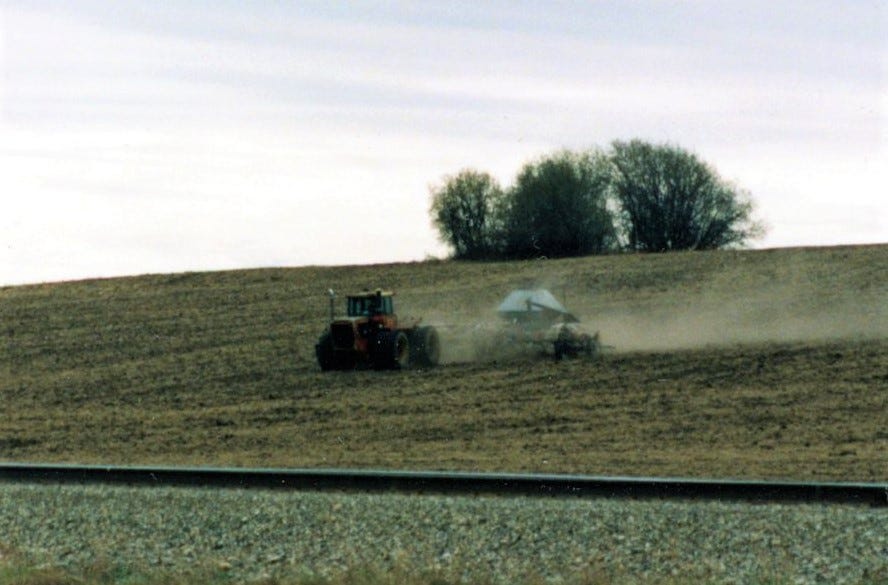
The Prime Minister is not only ignoring the concerns of farmers, but is actively implementing policies which are making a tough situation even worse, said John Barlow, Shadow Minister for Agriculture and Foothills MP, when he and local MP Bob Zimmer met with some North Peace farmers recently.
The group of farmers who met with MPs Zimmer and Barlow, are members of the North Pine Farmers’ Institute and the BC Grain Producers Association. They met to discuss a number of issues and concerns to farmers in the BC North Peace.
“We talked about carbon sequestration and climate change,” said Ernie Weibe. “And how farmers are actually being good stewards of the land, while providing safe, good food for Canadians, and doing it in an environmentally-friendly way. In a way that provides and promotes agriculture in Canada.”
But unfortunately, as Barlow says, the Federal government doesn’t see it this way. “We have a government in Canada right now, that looks at agriculture in an adversarial way, rather than being an advocate and a partner. The policies they are putting forward, they don’t realise that they have very real consequences.”
One of these consequences, is the impact the carbon tax is having on Canadian farmers. The government plans to triple the carbon tax by 2030, said Barlow. “It will cost an average 5,000 acre farm in Canada $150,000 in carbon tax alone. That puts economic viability, the sustainability of Canadian agriculture at risk.”
Another consequence, is double-digit food inflation. A study done by Dalhousie University, Barlow noted, has shown that if these policies stay in place, by 2030 the average grocery price will go up by 35 per cent.
“Canadians are the ones paying the price of the non-sensical carbon tax,” he said. “Farmers are paying for it.”
Hannah Willms, another local farmer and director with the BC Grain Producers Association, says she is advocating for the farmers in the Peace, through this role. She’s specifically working with the BC Agriculture Council and is an advisor to the BC Government on the new Sustainable Agriculture Strategy the government is planning.
“It’s really important that we have a voice in the Peace Country, because we are really different than the farms in the Lower Mainland,” Willms said. “We are not constrained by the population here, in fact we need the population up here to work on our farms.”
Willms has also been working with the Living Labs, which is measuring carbon sequestration on farms in the BC and Alberta Peace. Living Labs has begun to take soil samples around the Peace to measure the levels of carbon in the soil to establish benchmarks for the government. Carbon sequestration is the long-term storage of carbon in plants, soils and geological formations.
“Farmers pay carbon tax, but they don’t get credit for the carbon that they sequester,” said Zimmer. “Living Labs is doing the research, so they actually have a number, so that farmers can get credit for what they do in terms of sequestering carbon, and do what’s good for the environment.”
Wade Cusack, President of the North Pine Farmers’ Institute said that farmers face both environmental and economic challenges.
“There are huge hurdles for agriculture,” Cusack said. Envionmental challenges they don’t have much control over, but “when it takes many generations to make a farm business viable, we need more support from the government with programming that actually works on farms, and an understanding of the hard work that goes into the production of food for Canadians and the population around the world.”
One thing that is a real challenge, Cusack said, is the succession of the next generation into the farms. “When the younger generation is full of vim and vigour, and their passion is to farm, but the hurdels are so enormous that it turns them away – it’s a sad day for agriculture in Canada.”
“We need governments to look at the bigger picture for humanity that causes sustainable agriculture,” said Cusack.
The Federal government can’ solve all the problems, said Barlow. Things such as commodity prices and the weather are out of their control. But there are things that the government can give farmer, he said. A competitive regulatory tax regime which mean access to labour; an efficient supply chain; and programs that would work for farmers.
“The Liberal government is failing on all those things. But it highlights the things we need to accomplish to ensure agriculture and farm families are not only environmentally sustainable, and socially sustainable, but most importantly, economically sustainable.”

