'Don't Drain Our Lake': Resident Petitions to Preserve Inga Lake
Fall 2028 decommissioning of dam will destroy North Peace’s most popular recreation spot
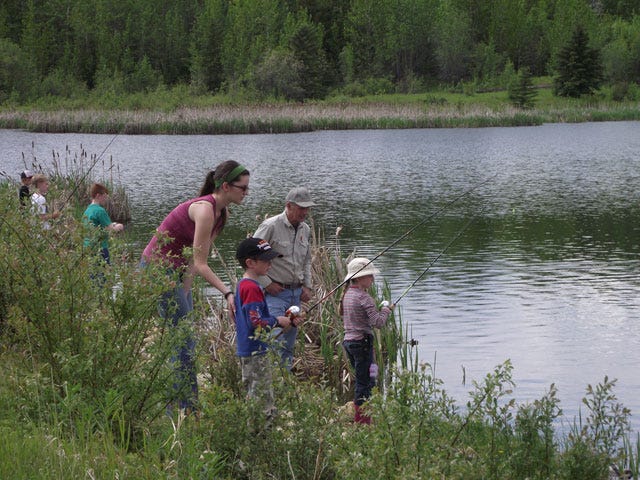
FORT ST. JOHN – The most popular recreation site in the North Peace is slated for decommissioning in the Fall of 2028, if funding can’t be found to repair or replace the earthen dam that makes Inga Lake possible.
As one of the few good fishing lakes in the region near Fort St. John, with good access, a boat launch and campsite, the 75-km-drive to reach Inga Lake has never stopped locals who want to take a in a weekend’s fishing, camping or other recreational opportunities with their families.
Inga Lake was created in 1970, originally for use in oilfield operations. Since 1973 it has been stocked annually with Rainbow Trout, and over the years has become a much-loved spot for generations of North Peace families.
The provincial government, in partnership with Ducks Unlimited Canada have been looking after the lake and dam, since the 1980s.


On January 27, representatives from Ducks Unlimited (DUC) and the Ministry of Water, Land and Resource Stewardship gave a presentation to the Peace River Regional District’s Rural Budgets Administration Committee (RBAC) outlining options for the future of Inga Lake and informing the board that the Inga Lake dam is scheduled to be “decommissioned” in 2028.
Earthen dams, like the one that created Inga Lake, typically have a 30-year lifespan. Thirty-six years have passed since DUC made major repairs in 1990, and now the dam is reaching the end of its life, Tara Lumley, Conservation Programs Specialist with DUC explained.
The main concern isn’t just the dam’s age, but seepage and slumping that is occurring around a manhole in the middle of the dam. This feature is left-over from the original 1970s construction, which Lumley believes was used to monitor water flow.
“Because it is a large dam, it is a high-consequence dam, which means if it were to blow-out, there could be public safety and other issues involved,” Lumley said. For example, the Inga Lake Road runs downstream from the dam.
In addition to the Rainbow Trout, Inga is home to many beavers that keep the lake’s caretakers busy clearing away debris. Ducks Unlimited spends approximately $3,200 per year on maintenance and management of the weir and dam, including removing debris accumulated by the beavers, according to Lumley.
“In terms of management, what that means for us is we have to go there often and clear out some of that debris that the beavers are doing,” she said.
Although DUC maintains the dam and the weir as per the 1980s agreement, it is actually the provincial government that owns the water license for the weir and it’s the Ministry of Water, Land and Resource Stewardship’s (WLRS) job to make sure the weir, the land around it and the fishery are looked after, James Morgan, Fish and Wildlife Section Head told RBAC.
The agreement between DUC and the Province was “to promote fish habitat, which unfortunately in Ducks Unlimited’s current purview,” Morgan said.
Now, with the problems at the Inga Lake dam, the distance DUC staff must travel to maintain the weir and dam, Ducks Unlimited wants out, and Morgan says that WLRS has few options for the lake going forward. He has spent the last year looking for funding options to repair or replace the dam, but none support this type of infrastructure maintenance.
The Province has looked at “a ton of different options in terms of funding for weir repairs, and unfortunately it’s such a specific niche that [these sources] have caveats that won’t fund weir repairs or maintenance,” Morgan said.
“I don’t think I would be a very good public servant if I didn’t stop until I was told no by almost absolutely everybody,” he said of his efforts.
The cheapest and quickest solution to seepage and slumping at the dam is decommissioning. An option that would cost approximately $70,000, but would destroy what has become, over the course of more than 50 years, the most popular recreation site in the North Peace.
Conducting a safety review is estimated to cost between $100,000 - $250,000 and depending on what is learned during such a review, repairs could run another $250,000 - $300,000, while a rebuild could cost upwards of $1.2 million.
After hearing about the January 27presentation, and what appears to be the imminent destruction of a much-loved recreational area, Fort St. John resident Emily Pollington launched a petition to save Inga Lake.
In her petition, Pollington describes Inga Lake as “a well-loved public lake used year-round for fishing, camping, education, wildlife viewing, and local tourism.” A place that families, residents, First Nations and visitors to the region rely on for recreation.
“There’s also a spawning channel project on Inga Lake that began in the late 1990s to support fish reproduction and education for students to learn about fish life cycles. Many families write about teaching their children to fish on this lake and have memorable camping trips here.”
The petition calls on the provincial government to:
Commit funding for the repair and future maintenance of the Inga Lake dam
Explore provincial and federal infrastructure funding options
Engage meaningfully with local communities, Indigenous Nations, recreation groups, and environmental experts
Recognize Inga Lake as critical public recreational infrastructure worthy of preservationThe cost of decommissioning may seem smaller than actioning this but ultimately, draining the lake will be a far greater cost than the cost of repair. Once this lake is lost, it cannot simply be rebuilt.
Save Inga Lake. Repair the dam. Protect our shared public resource — now and for future generations.
Peace River North MLA Jordan Kealy was surprised to learn that the Inga Lake dam may be decommissioned and the lake drained.
Although Lumley told RBAC that the decommissioning and draining of the lake would result in the area returning to its original state, Kealy suspects that the water might just dry up altogether, not even leaving a habitat for ducks or any wildlife and making the Inga Lake campsite pointless.
“My perspective is, we have very few recreational areas in our region, where people can go and spend time and enjoy themselves when it comes to camping and fishing,” Kealy said.
“It seems a lot of those are being deprioritized by the Province. Especially when it comes to Crown lands and access, when it comes to hunting and trapping regulations, new ones coming out, it’s becoming more difficult.
“It’s just making rural life more difficult and that’s the whole reason why we live in these areas, is because of the rural way of life,” he said.
People come here for the jobs as well as the rural way of life, Kealy said, but when outdoor recreation opportunities disappear, it makes the region less attractive.
“It definitely has cultural value to a lot of the residents in the region.”
Kealy added that the response he’s seen from the public regarding Inga Lake has been overwhelming, with his Facebook post alone getting some 40,000 views.
“[And] with a lot of comments about how much people love it dearly, they’ve been there as children. It’s been there for a long time, and that facility just got upgraded back in 2021, so it’s not like it hasn’t had recent investment put into it.
“They’ve known for awhile that that dam would need an investment. I think that the sooner they dip into putting some money into it, the less it will be on the major side of fixing it.”
Area B director Reid Graham asked about the possibility of the Regional District taking Inga Lake on.
Shawn Dahlen, the PRRD’s Chief Administration Officer, said that “there’s always opportunities through regional or community parks to take on projects like this, if the electoral area director and/or regional board decided to do so.
“There’s probably also opportunities for collaborative partnerships potentially with other agencies, as well as First Nations, if it was something that either wanted to be explored as a community park or regional park.”
“What we actually want is for people to travel to Inga Lake, have a good time out on the lake, to be able to catch fish, enjoy it with their family and maybe take home a couple [of fish] if they can,” Morgan said.
None of which can happen if the dam and weir are decommissioned. To support Emily Pollington’s campaign to save Inga Lake, check out the petition. As of February 2nd, the petition has 764 signatures.


