Councillor says FSJ should stop providing water to rural residents
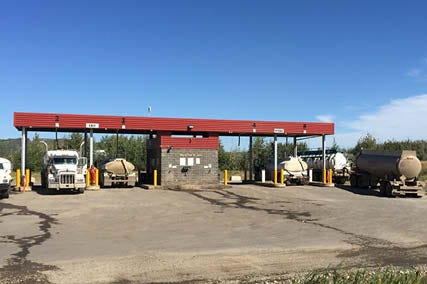
In the wake of concerns expressed by rural residents surrounding the upcoming three-week closure of the bulk water station on the West Bypass Road near Ma Murray Community School, Fort St. John city councillor Byron Stewart wants the city to wash its hands of the service altogether.
Last week the City of Fort St. John announced the coming closure, from July 3 to 22 for paving of the severely deteriorated lot surrounding the rural water station and the subsequent temporary closure for a system upgrade of all water station software from July 22 to 29. This means that individuals and commercial water hauling businesses will be unable to access the station for almost a month. Given that a load of water in most cisterns lasts 15-16 days, having access to the water station that thousands of rural residents rely on cut off for such a long time has users concerned.
“I would honestly prefer that we start looking at shutting it down. Completely.” ~ Councillor Byron Stewart
The wear on the driving surface at the water station has been accelerated by the heavy commercial traffic, leading to the development of large potholes. On January 1, the city increased the water dispensing rates at the station by 66 percent, partly in anticipation of the project. Water and sewer rates are reviewed annually in order to ensure that the city is recovering its costs for providing the service to all residents, and to ensure sufficient funds are collected to cover future infrastructure needs. The repaving of the lot surrounding the water station is one of these infrastructure needs, one that Mayor Lilia Hansen noted users had been asking for.
“What has happened over time is that the paving surface has become less and less usable, and more and more damaged, so there was an urgency to getting that resolved,” said Fort St. John’s Chief Administrative Officer, Milo MacDonald.
“We’ve had conversations with staff and the contractor will do their best to get this resolved as quickly as possible, and I think that the period of time when the site will be entirely blocked will be much shorter than three weeks,” MacDonald said.
The water station provides water mainly to residents of Area C, through the use of commercial delivery services or individual residents hauling their own water from the facility, or the second site at Charlie Lake. Residents of Area B can use these facilities as well, but unlike in Area C, there are five other water stations scattered throughout Area B for residents to use.
Area B’s water stations utilize water from wells in the area, but the ones operated by the City of Fort St. John use water from the five wells under the Peace River in Taylor which have supplied the municipality with water since the late 1990s. Prior to the development of the Peace River wells, the city’s water supply came from Charlie Lake. The water from these wells also supplies parts of Charlie Lake and the Airport Subdivision.
Following the city’s announcement of the station closure to carry out the repaving project, some of the 12,400 rural residents, plus a few city residents who are not yet connected to the municipal water system, voiced their objections to the closure, both on social media and by contacting local government.
It was these objections that prompted Stewart to suggest a permanent closure of the water station.
“This is $1.4 million that our residents are putting forth for a capital project that benefits a majority of not our residents,” Stewart said. “For us to get beat up and questioned about it bothers me.”
“I would honestly prefer that we start looking at shutting it down. Completely. And have Areas B and C provide the services that their residents are asking for. Not the City of Fort St. John.”
Stewart added that he doesn’t understand why the city “continues to supply the region out of the taxpaying dollars of our residents.”
However, according to the city’s own financial statements, funding for capital projects comes out of the Peace River Agreement, as well as the water and sewer reserves, not taxes.
Since bringing in water meters in 2007, the water and sewer billing process has evolved into a full-cost recovery model, which was adopted in 2012. This means that no taxes are collected to pay for the water and sewer infrastructure. Instead, it’s self-sustaining, by having the bulk of the revenue going into the reserves. This supports operational costs, major project costs, replacement, and new infrastructure costs.
January’s 66 percent rate increase at the water station is meant to at least partially offset the cost of construction. Rural residents who rely on the supply at the water station now pay $5 per cubic metre, compared to the $1.95 per cubic metre that residents of the city pay. Commercial haulers who deliver to rural residents pay $10 per cubic metre.
So, all water users, not just city residents, pay into the reserves to maintain the water services provided by the city.
“I’m just a little surprised that he would say that without having a conversation first.” ~ Area C Director Brad Sperling
Area C director Brad Sperling says he’s heard from quite a few residents about the upcoming closure of the water station, noting that there was already a high level of anxiety among residents before councillor Stewart’s statement on Monday.
Statements like Stewart’s are discouraging for relationships, says Sperling.
“I get the anxiety and it’s not great, but I appreciate what the city is doing – I’m just a little surprised that he would say that without having a conversation first. I’m surprised that someone who has sat on council for that long and knows the reputations of mutual togetherness would say something like that,” he said.
Sperling noted that the city and the regional district put a lot of effort into building relationships with their neighbours, whether they’re rural residents or other municipalities, and Stewart’s stated desire to cut off the water supply to Fort St. John’s rural neighbours is “not a good way to build relationships.”
“When I hear things like that, it really irks me when it comes to building relationships, it does no good without at least having a talk first. Are those the sentiments of the whole council? What are my people supposed to think?”
Area C, with the approval of the board of the Peace River Regional District, has been working on obtaining a water license for Charlie Lake, but unfortunately the process is very slow. In the meantime, Sperling says he appreciates the city’s efforts to repair the parking area at the West Bypass Water Station.
“The city is putting up the effort to make sure that gets repaired for our use, and I thank them for that, I appreciate that they’re doing that for us while we look for our own service,” he said. “Key is whether we can get a water license or not, and when you’re looking at lakes or rivers, it’s not just provincial, it’s also federal. It’s just a slow process, but it’s a process that I can’t speed up. Everything takes time.”
“This project has highlighted how vulnerable it could be if we somehow lost our water filling station, and the importance of working with our regional partners,” said Hansen.
Sperling urged rural residents to top up their cisterns before July 3 and to try not to worry.
“It’s caused some anxiety and concerns, but there is other access to water – people just need to top up their tanks and hopefully the city is right, and it’ll take less than the whole three weeks.”


